
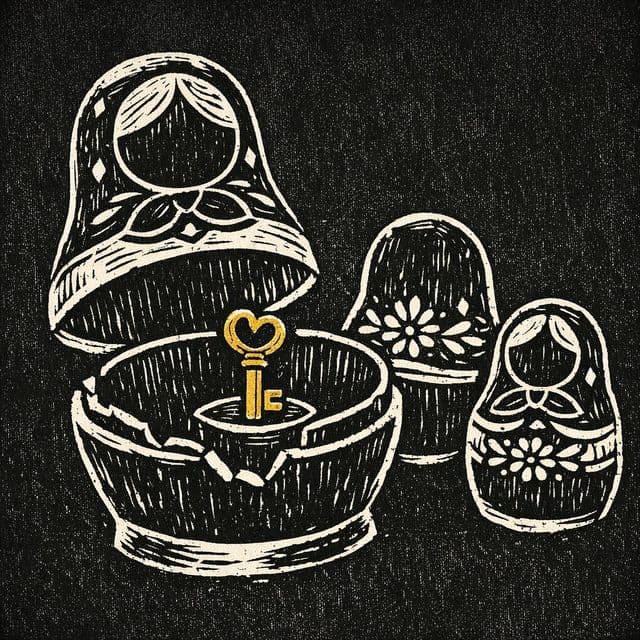
Fetal microchimerism: the children who stay inside you
During pregnancy, cells pass from fetus to mother and can persist for decades, turning up in her blood, organs, and even her brain. Explore this astonishing biological blurring of self and other, and what science is learning about its effects.
Listen in the Fylom app.
Fetal cells cross the placenta and can persist in a mother's body for over forty years.
Male fetal DNA has been discovered in the brains of women in their nineties.
Fetal cells migrate to damaged maternal organs to transform into functional heart muscle and neurons.
Microchimerism allows siblings to exchange cells with one another through their mother's body.
Higher levels of fetal microchimerism are linked to a lower risk of developing breast cancer.
Fetal cells aid maternal recovery by releasing collagen to minimize scar tissue after cesarean sections.
- 01Intro1 min
- 02The Discovery of the Cellular Guest2 min
- 03The Brain and the Heart: Where They Go3 min
- 04The Double-Edged Sword of Immunity3 min
- 05The Multigenerational Web2 min
- 06Outro1 min
- Fetal microchimerism and maternal health during and after pregnancy
- Fetal–Fetal and Fetal–Maternal Microchimerism: Insights from Mammalian Placental Biology
- Feto-maternal microchimerism: Memories from pregnancy - PMC
- Fetal microchimerism and maternal health: A review and evolutionary analysis of cooperation and conflict beyond the womb - PMC
- Maternal microchimeric cell trafficking and its biological consequences depend on the onset of inflammation at the feto-maternal interface | Seminars in Immunopathology | Springer Nature Link
- Millions of Your Mother's Cells Persist Inside You, And Now We Know How : ScienceAlert
- Beyond the Biological Souvenir: The Evolving Landscape of Fetal Microchimerism - Harvard Science Review
- Cells that are not our own may unlock secrets about our health | News
- Deeper Microchimerism Study Sheds New Light on a Mother's ...
- Maternal-Fetal Microchimerism: Impacts on Offspring's Immune Development and Transgenerational Immune Memory Transfer - PMC
- The ‘communicatome’ of pregnancy: spotlight on cellular and extravesicular chimerism | EMBO Molecular Medicine | Springer Nature Link
- Tissue microchimerism is increased during pregnancy: a human autopsy study
- Microchimerism and pregnancy complications with placental dysfunction | Seminars in Immunopathology | Springer Nature Link
- Fetal microchimerism and implications for maternal health
- Clinical relevance of feto-maternal microchimerism in (hematopoietic stem cell) transplantation - PMC
- Transfer of Fetal Cells With Multilineage Potential to Maternal Tissue
- Male Microchimerism in the Human Female Brain
- Cell Migration from Baby to Mother - PMC - NIH
- Cell Migration from Baby to Mother
- Frontiers | Presence of fetal microchimerisms in the heart and effect on cardiac repair
- Synergies of Extracellular Vesicles and Microchimerism in Promoting Immunotolerance During Pregnancy
- Frontiers | Synergies of Extracellular Vesicles and Microchimerism in Promoting Immunotolerance During Pregnancy
Fylom generates episodes like this on any topic you're curious about.
Fylom episodes are researched, written, and voiced by AI. Automated checks help catch inaccuracies, but episodes aren't reviewed by a human and AI can still get things wrong. Treat them as a starting point, not a source of record — more in our accuracy disclaimer.