
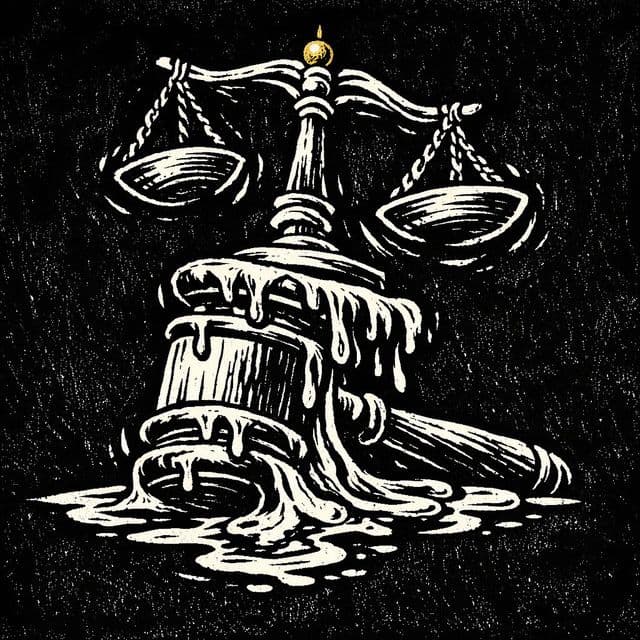
Plea bargaining and the trial that almost never happens
An exploration of how the American criminal justice system transitioned from a trial-based model to a plea-negotiation machine, and the resulting 'trial penalty' that shapes modern justice.
Listen in the Fylom app.
Ninety percent of federal defendants enter a guilty plea rather than facing a jury trial.
Federal sentences for jury trials are two to six times longer than those offered in plea deals.
One quarter of individuals cleared by DNA evidence originally pleaded guilty to avoid trial risks.
President Lyndon Johnson’s nineteen sixty-seven commission officially endorsed plea bargaining to prevent administrative court paralysis.
Private negotiations prevent legal precedents and hide police misconduct from public oversight and transcripts.
Charge stacking allows prosecutors to inflate potential sentences to force defendants into accepting plea bargains.
- 01Intro1 min
- 02The Death of the Jury Trial2 min
- 03The Normalization of the Bargain3 min
- 04The Trial Penalty and Coercion4 min
- 05A System Without Oversight2 min
- 06Outro1 min
- WHEN PLEA BARGAINING BECAME NORMAL
- When “Choice” is Not a Choice: The Trial Penalty’s Grip on Jury Trials - Richmond Public Interest Law Review
- Bargaining with the Sixth Amendment: The Role of Risk Aversion and “Trial Penalties” in Plea Bargaining — Duke Undergraduate Law Review
- Most criminal cases end in plea bargains, new study finds : NPR
- Plea Bargains: Efficient or Unjust? - Judicature - Duke University
- The Rise of Plea Bargains and Decline of the Right to Trial | ACS
- Bargained Justice: The History and Psychology of Plea Bargaining and the Trial Penalty
- Plea Bargaining's Uncertainty Problem | Texas ...
- In the Shadows
- The Repeal Of The Sixth Amendment By The Courthouse Crowd | The Plea | FRONTLINE | PBS
- Plea Bargain Task Force Report
- New effort tries to focus attention on the trial penalty for defendants : NPR
- Fourteen Principles and a Path Forward for Plea Bargaining Reform
- In the Shadows: A Review of the Research on Plea Bargaining
- The Vanishing Criminal Jury Trial: From Trial Judges to Sentencing Judges
- The Invisible Revolution in Plea Bargaining: Managerial Judging and Judicial Participation in Negotiations
- PLEA BARGAINING AND THE ECLIPSE OF THE JURY | Annual Reviews
- Plea Bargaining and its History
- Plea Bargaining Abolitionism: A History
- Plea Bargaining and Prohibition in the Federal Courts, 1908–1934
- Trials and Tribulations: The Trial Tax and the Process of Punishment
- PLEA BARGAINING AND MASS INCARCERATION
- https://www.nacdl.org/getattachment/95b7f0f5-90df-4f9f-9115-520b3f58036a/the-trial-penalty-the-sixth-amendment-right-to-trial-on-the-verge-of-extinction-and-how-to-save-it.pdf
Fylom generates episodes like this on any topic you're curious about.
Fylom episodes are researched, written, and voiced by AI. Automated checks help catch inaccuracies, but episodes aren't reviewed by a human and AI can still get things wrong. Treat them as a starting point, not a source of record — more in our accuracy disclaimer.