
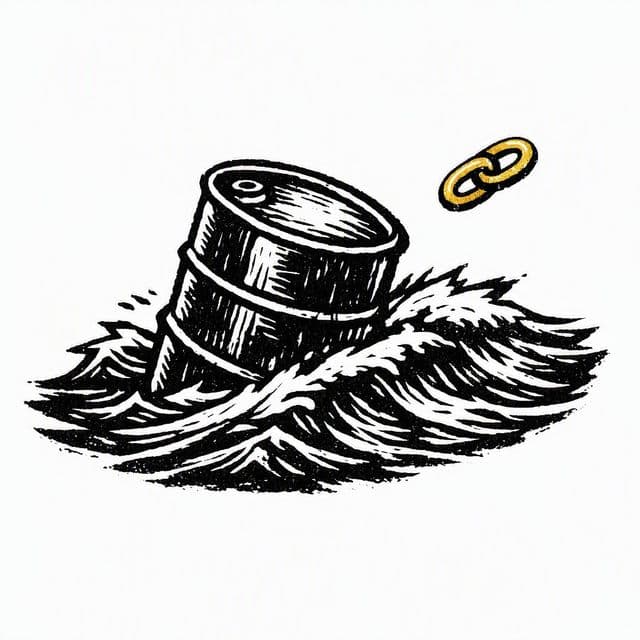
Iran to Declare Gulf Exclusion Zone Threatening US-Escorted Tankers
Iran's Supreme National Security Council chief Mohsen Rezaei says Tehran will soon declare a new restricted zone extending from the US naval blockade line, threatening to sanction any ship that enters. This raises the specter of a wider naval confrontation and fresh disruption to oil that flows to global markets. Listen for what the exclusion zone actually means for US Navy escort operations and whether it forces another round of tanker strikes.
Listen in the Fylom app.
Iran is using geographic ambiguity to declare maritime exclusion zones as a reaction to United States naval blockades.
Tehran claims their oil exports remain steady at one million to one and a half million barrels daily.
United Nations Resolution twenty-eight seventeen establishes international consensus on the freedom of navigation in these waters.
Maritime insurers act as silent regulators by raising premiums or withdrawing coverage for high-risk transit zones.
A total closure of the Strait of Hormuz could remove twenty percent of the global oil supply.
Eighty percent of the crude oil passing through the Strait is destined for Asian markets.
- 01Intro1 min
- 02The Declaration from Tehran2 min
- 03Navigational Ambiguity and the U.S. Response3 min
- 04The Law of the Sea vs. Operational Reality2 min
- 05The Global Oil Shock2 min
- 06Outro1 min
- Iran Says It Plans To Announce New 'Exclusion Zone' Near ...
- US-Iran war: Tehran plans Hormuz exclusion zone as ...
- Iran, June 2026 Monthly Forecast
- [PDF] Joint Maritime Information Center JMIC Advisory Note
- What the closure of the Strait of Hormuz means for ...
- The Legal Regime of the Strait of Hormuz and Attacks ...
- From chokepoint to crisis: The Strait of Hormuz and global ...
- How Will the Iran Conflict Impact Oil Prices? - Goldman Sachs
Fylom generates episodes like this on any topic you're curious about.
Fylom episodes are researched, written, and voiced by AI. Automated checks help catch inaccuracies, but episodes aren't reviewed by a human and AI can still get things wrong. Treat them as a starting point, not a source of record — more in our accuracy disclaimer.