
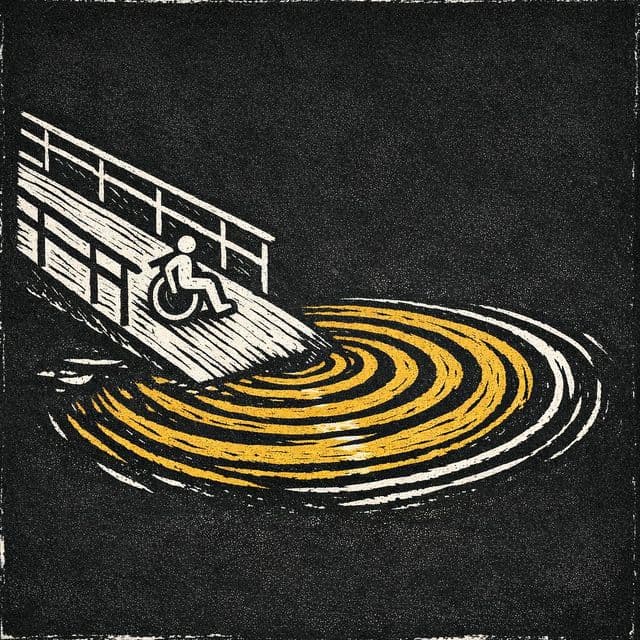
Universal design and the curb cut effect
Features created for disabled people — curb cuts, captions, ergonomic tools — routinely end up helping everyone. Explore how designing for the margins quietly improves the built world for all of us.
Listen in the Fylom app.
Nine out of ten unencumbered pedestrians choose curb cuts over standard six-inch vertical drops.
Eighty percent of people using television captions are not hearing impaired.
The typewriter originated in eighteen oh eight as a bespoke tool for a blind Countess.
Retrofitting for accessibility costs ten times more than proactive universal design during original site planning.
Voice assistants like Siri and Alexa originated from research into motor impairment accessibility.
Lever door handles allow people to enter rooms while carrying groceries or sleeping children.
- 01Intro1 min
- 02The Slab of Concrete Heard Round the World2 min
- 03The Digital Curb Cut: Captions and Typewriters3 min
- 04The Mechanics of Universal Design3 min
- 05The Future: AI and Predictive Accessibility3 min
- 06Outro1 min
- Curb cut effect
- How building with people who face barriers benefits everyone, especially during crises
- Designing spaces with marginalized people in mind makes them better for everyone
- Curb Cuts - 99% Invisible
- The Curb-Cut Effect
- The curb cut effect and universal product design | by Jim Ryan | UX Collective
- The Curb Cut Effect: 7 Everyday Hacks You Wouldn't Have Without Disabled People - Chronically Jenni
- The Digital Curb-Cut Effect: How Designing for the Edges Benefits Everyone
- Using the Curb-Cut Effect to Advocate for Digital Accessibility - ReadSpeaker
- The Curb Cut Effect, with AI: how accessibility quietly designs the future
- They Took Sledgehammers to Sidewalks – Here’s Why | The Curb Cut Effect | American Experience | Official Site | PBS
- https://americanhistory.si.edu/explore/stories/smashing-barriers-access-disability-activism-and-curb-cuts
- Creating Curb Cuts - Encore Magazine
- The Blind Countess and the Birth of the Typewriter (Case Study in Design Amplification)
- Sam's Stuff - Accessibility, the Origin of Innovation
- The Machine That Gave Voice to Silence - Snake River Valley Chapter
- American Experience | They Took Sledgehammers to Sidewalks – Here’s Why | The Curb Cut Effect | Season 37 | Episode 2 | PBS
- Curb cut
- They Took Sledgehammers to Sidewalks – Here’s Why | ASL | The Curb Cut Effect | American Experience | Official Site | PBS
- Talking Headways Podcast: Ed Roberts, Curb Cuts and the Origins of the Disability Movement — Streetsblog USA
Fylom generates episodes like this on any topic you're curious about.
Fylom episodes are researched, written, and voiced by AI. Automated checks help catch inaccuracies, but episodes aren't reviewed by a human and AI can still get things wrong. Treat them as a starting point, not a source of record — more in our accuracy disclaimer.