
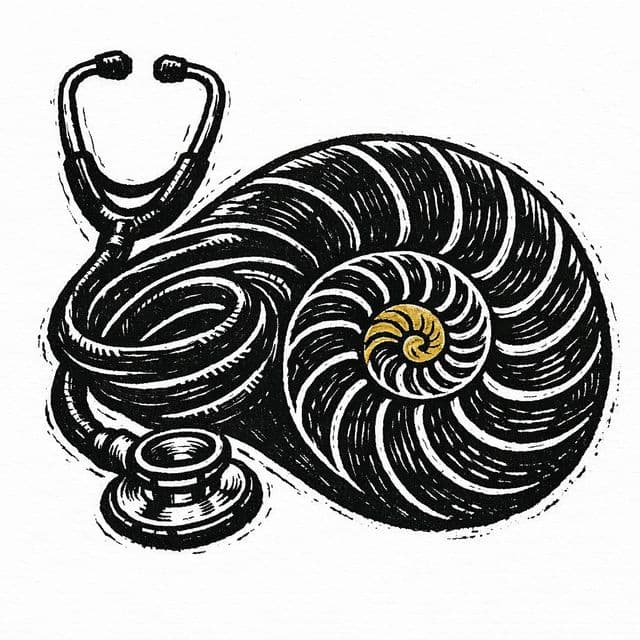
Interoception: the sense that reads your own body
Beyond the classic five senses lies interoception — your perception of your internal state, from heartbeat to hunger. Explore how it works and its surprising links to emotion, anxiety, and the way we make decisions.
Listen in the Fylom app.
Eighty percent of vagus nerve fibers send signals from the body to the brain, not the reverse.
Three-bladed propeller proteins called PIEZO translate physical pressure from organs into electrical brain signals.
The insula serves as the primary hub where the brain processes internal physiological data.
Reframing physical stress symptoms as preparation for a challenge can alter the body's hormonal response.
Anxiety disorders often cause the brain to interpret benign internal signals as immediate physical threats.
Current vagus nerve stimulation treatments lack precision by affecting multiple internal organs at the same time.
- 01Intro1 min
- 02The Hidden Continent of Awareness2 min
- 03The Molecular Mechanics: PIEZO and the Vagus3 min
- 04The Braid of Emotion and Physiology3 min
- 05When the Signal Fails: Anxiety and Health3 min
- 06Outro1 min
- Inside interoception: The hidden sense of how you feel inside | MIT Technology Review
- The Emerging Science of Interoception: Sensing, Integrating ... - PMC
- Interoception: Definition, Symptoms & How To Improve
- Making Sense of Interoception | Harvard Medicine Magazine
- What Is Interoception? The Brain's Internal Sensing | Neurosity
- Interoception: The Body’s Hidden Sixth Sense - I Spy Physiology Blog
- The Coding Logic of Interoception | Annual Reviews
- Interoception
- Interoception and gut–brain communication
- The Hidden Sense (Interoception) Part 1 - Building Resilience | Acast
- Interoception - Scholarpedia
- Mapping the Sense of What’s Going On Inside | Carl Zimmer
- Vagus nerve
- How do you feel? Interoception: the sense of the physiological condition of the body | Nature Reviews Neuroscience
- A multidimensional coding architecture of the vagal interoceptive system | Nature
- PIEZO channels are opening the study of mechanosensation in unexpected places | The Transmitter: Neuroscience News and Perspectives
- PIEZO ion channels : The Journal of Physiology
- Cardiovascular PIEZO discovery continues apace to reveal myocardial nerves feeling posture and blood loss | Nature Cardiovascular Research | Springer Nature Link
- Interoception: A sense of self - Scripps Research Magazine
- Mapping the Sense of What’s Going On Inside – DNYUZ
- Interoceptive Mechanisms and Emotional Processing | Annual Reviews
- Functions of Interoception: From Energy Regulation to Experience of the Self
Fylom generates episodes like this on any topic you're curious about.
Fylom episodes are researched, written, and voiced by AI. Automated checks help catch inaccuracies, but episodes aren't reviewed by a human and AI can still get things wrong. Treat them as a starting point, not a source of record — more in our accuracy disclaimer.