
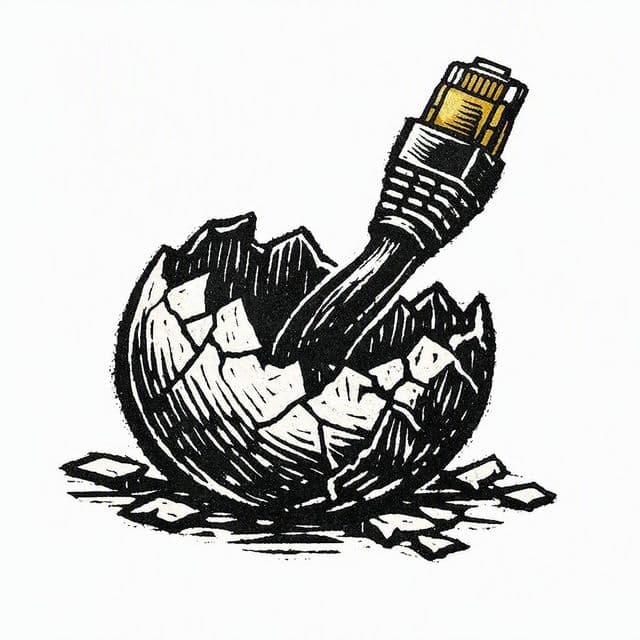
The Experiment That Escaped: The 1988 Morris Worm
In November nineteen eighty-eight, a graduate student's experiment to measure the internet's size accidentally became the first major internet worm. This is the story of how a single coding flaw froze ten percent of the web and forced the world to invent modern cybersecurity response.
Listen in the Fylom app.
The nineteen eighty-eight internet consisted of only sixty thousand machines built on a foundation of mutual trust.
A one-in-seven reinfection rule caused the software to replicate exponentially and crash systems nationwide.
The worm exploited a debugging back door in sendmail and buffer overflow vulnerabilities in the fingerd service.
Administrators were forced to physically pull network cables out of walls to stop the digital infection.
Robert Tappan Morris received the first conviction under the nineteen eighty-six Computer Fraud and Abuse Act.
The incident led to the creation of the first formal digital emergency response organization at Carnegie Mellon.
- 01Intro1 min
- 02The Launch at MIT2 min
- 03The Flaw in the Count2 min
- 04Exploiting the Trust3 min
- 05The Birth of Incident Response2 min
- 06Outro1 min
- Student Testifies His Error Jammed Computer Network
- Computer hacker says 'worm' went out of control
- Morris worm
- Morris Worm
- The Morris Worm, The Hacker Culture Museum
- The 'Morris Worm': A Notorious Chapter of the Internet's Infancy
- Robert Tappan Morris - Wikipedia
- The Robert Morris Internet Worm - Research
- In 1988, One Rogue Worm Shut Down 10 Percent Of The Internet
- How did a Cornell graduate student's 99-line bootstrap program in November 1988 infect roughly 6,000 machines — about 10 per cent of the early internet — and force universities to invent the first computer emergency response team?
- Morris Worm - Radware
- The first computer virus to spread across the global internet ...
- Attacks from Outside the Operating System
- The Morris Worm Turns 30
- United States of America, Appellee, v. Robert Tappan Morris ...
- The Morris Worm | Federal Bureau of Investigation
- The 1988 Morris worm, the internet's first cyberattack - LLNL
- Crisis and Aftermath
- infecting ten percent of all connected computers in hours and ...
- The Morris Worm: The Turning Point of Cybersecurity
Fylom generates episodes like this on any topic you're curious about.
Fylom episodes are researched, written, and voiced by AI. Automated checks help catch inaccuracies, but episodes aren't reviewed by a human and AI can still get things wrong. Treat them as a starting point, not a source of record — more in our accuracy disclaimer.