
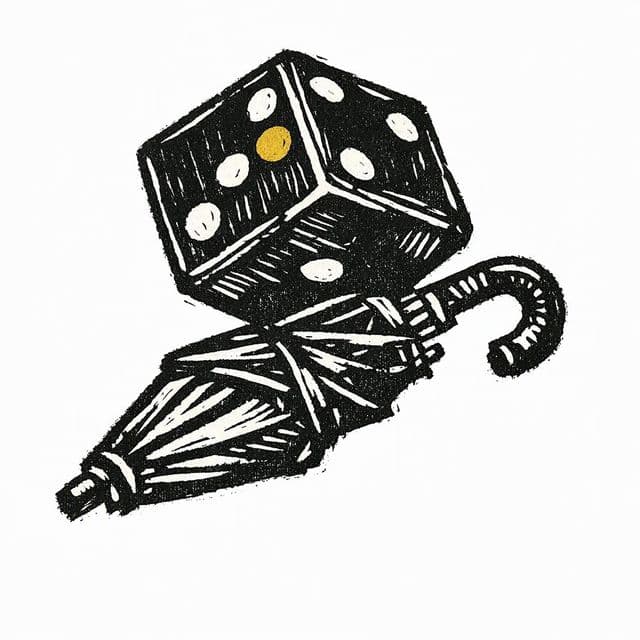
Pascal's Wager and the Mathematics of Faith
Blaise Pascal, pioneering mathematician of probability theory, framed religious belief as a bet with calculable stakes. This episode examines the logic of his wager in the Pensees, the philosophical objections that destabilize it, and what happens when spiritual conviction is treated as an expected value calculation.
Listen in the Fylom app.
Pascal used gambling mathematics from an interrupted game puzzle to frame faith as a forced decision.
Any non-zero probability multiplied by infinite eternal gain yields infinite expected value.
The math breaks down when multiple rival religions each promise an infinite payoff.
Infinite payouts allow randomized strategies like rolling dice to claim infinite expected value.
Pascal advised secular skeptics to adopt physical religious rituals to cultivate genuine belief indirectly.
- 01Intro1 min
- 02The Gambler's Impasse3 min
- 03The Mathematics of Infinity3 min
- 04The Collapse of the Matrix4 min
- 05Habit, Psychology, and Truth3 min
- 06Outro1 min
- Pascal's wager - Wikipedia
- Pascal's Wager: probability and faith in mathematical analysis | Tangente Magazine
- 6 Pascal's Wager.pdf
- Pascal’s Wager (Stanford Encyclopedia of Philosophy)
- Pascal's Wager and Its Postmodern Counterpart
- Pascal wager.pdf
- routledge.com
- vaticanobservatory.org
- davidpublisher.com
- 8 pascal.pdf
- Pascal’s Wager: A Pragmatic Argument for Belief in God - 1000-Word Philosophy: An Introductory Anthology
- Objection to pascals wager i dont see this argument being made
- Is It Rational to Believe in God? 5 Objections to Pascal’s Wager | TheCollector
- An Epistemic Version of Pascal's Wager | Journal of the American Philosophical Association | Cambridge Core
- Response to Common Objection of Pascal's Wager - The Philosophy Forum Archive
- Pascal’s Wager (Stanford Encyclopedia of Philosophy/Spring 2022 Edition)
- asburyseminary.edu
- Pascal’s Wager - The Philosophers' Magazine Archive
- The Many-Gods Objection to Pascal’s Wager: A Defeat, then a Resurrection (Chapter 7) - Pascal's Wager
- 249882604 Waging War on Pascal's Wager
- Waging war on pascal s wager 36rk0odobq.pdf
- Pascal's Wager > Notes (Stanford Encyclopedia of Philosophy/Spring 2016 Edition)
- Pascal’s Wager > Notes (Stanford Encyclopedia of Philosophy)
- The evidentialist objection
- Would pascals wager hold validity if doxastic involuntarism were true
- Pascal's Wager - 3:16
Fylom generates episodes like this on any topic you're curious about.
Fylom episodes are researched, written, and voiced by AI. Automated checks help catch inaccuracies, but episodes aren't reviewed by a human and AI can still get things wrong. Treat them as a starting point, not a source of record — more in our accuracy disclaimer.