
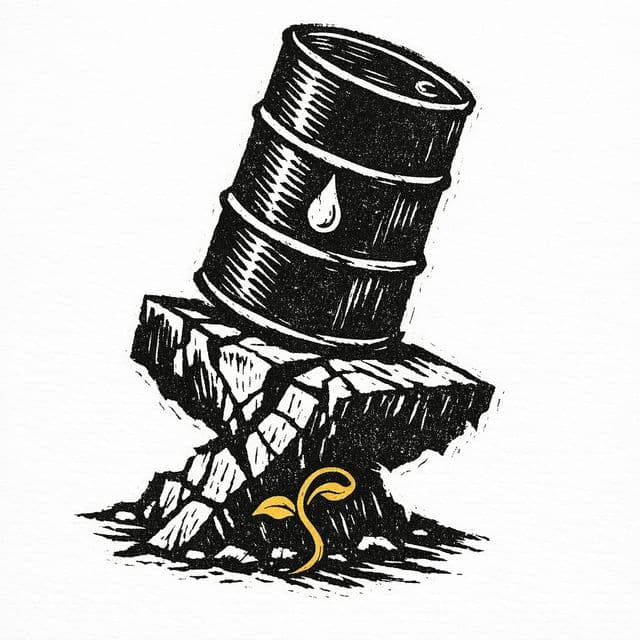
The resource curse: why oil-rich countries often end up poorer
Nations blessed with oil, gas, or diamonds frequently suffer slower growth, more corruption, and less freedom than resource-poor peers. Explore the political economy behind this paradox and the countries that escaped it.
Listen in the Fylom app.
Resource exports strengthen domestic currency, making local manufacturing and tech sectors too expensive to compete globally.
Rentier states often prioritize funding military loyalty and patronage networks over providing broad public goods.
The ratchet effect makes it politically impossible for governments to cut public spending when commodity prices crash.
Norway prevents Dutch Disease by using sterilization to keep its currency value stable against oil wealth.
Botswana avoided the resource curse by establishing democratic institutions and property rights before discovering diamonds.
Chile manages copper price volatility by following a structural surplus rule for counter-cyclical spending.
- 01Intro1 min
- 02The Dutch Disease and Economic Crowding3 min
- 03The Political Economy of Rent-Seeking3 min
- 04Volatility and the Boom-Bust Trap2 min
- 05The Exceptions: How Norway and Botswana Escaped3 min
- 06Outro1 min
- The Resource Curse
- The Natural Resource Curse: A Survey
- What Have We Learned about the Resource Curse?
- Chapter 2. The Natural Resource Curse: A Survey of ...
- WIDER Working Paper 2020/123-The political economy of the ‘resource curse’: a development perspective
- Is the resource curse persistent? Dynamic causality evidence from resource-dependent economies - ScienceDirect
- doi:10.1016/j.jdeveco.2006.01.008
- Resource abundance: A curse or blessing?
- Introduction
- Using Natural Resources for Development: Why Has It Proven So Difficult?
- 40 Years of Dutch Disease Literature: Lessons for Developing Countries - PMC
- Resource booms and the energy transition: What can we learn from Dutch economists' response to the discovery of natural gas reserves (1959–1977)?
- Dutch disease
- World Bank Document
- The Structural Manifestation of the `Dutch Disease’: The Case of Oil Exporting Countries; by Kareem Ismail; IMF Working Paper 10/103; April 1, 2010
- Back to Basics -- Dutch Disease, Finance & Development, March 2003, Volume 40, Number 1
- 9781513586342.pdf
- Oil, Disinflation, and Export Competitiveness: A Model of the "Dutch Disease"
- Dutch Disease: Wealth Managed Unwisely
- Taxation, Accountability, and Cash Transfers
- Does natural resource hinder, taxation capacity and accountability? A case of selected oil abundant developing countries | Journal of Social and Economic Development | Springer Nature Link
- World Bank Document
- Oil Rents, Corruption, and State Stability: Evidence From Panel Data Regressions; Rabah Arezki and Markus Brückner; IMF Working Paper 09/267; December 1, 2009
- The Political Economy of the Natural Resource Curse: A Survey of Theory and Evidence By Robert T. Deacon
- NATIONAL BUREAU OF ECONOMIC RESEARCH 1050 Massachusetts Avenue Cambridge, MA 02138 March 2010
- It's the rents, stupid! The political economy of the resource curse ☆
- Natural Resources and Rent Seeking Collusion in the Context of Dutch Disease - Istanbul Journal of Economics
Fylom generates episodes like this on any topic you're curious about.
Fylom episodes are researched, written, and voiced by AI. Automated checks help catch inaccuracies, but episodes aren't reviewed by a human and AI can still get things wrong. Treat them as a starting point, not a source of record — more in our accuracy disclaimer.