
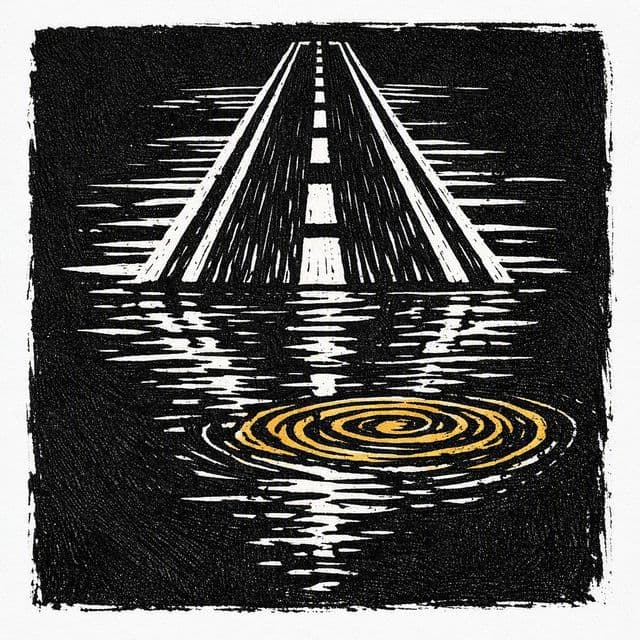
The Pilots Who Saw a Runway That Wasn't There
In the early jet era, experienced crews flew perfectly functional aircraft into the ground on clear nights over dark water. This episode explores the black-hole approach illusion—a phenomenon where the brain fabricates a sense of altitude and distance from missing sensory information, leading to fatal misjudgments in the cockpit.
Listen in the Fylom app.
Moonless nights and unlit terrain create black-hole conditions that cause pilots to overestimate their altitude.
Experienced flight instructors in Boeing simulators consistently flew miles short of runways during black-hole tests.
The brain uses perceptual filling-in to create a coherent reality even when sensory data is missing.
A nineteen sixty-five United Airlines crash into Lake Michigan highlights the danger of featureless approach environments.
Pilots often feel subjective confidence in their flight path while ignoring objective warnings from instrument dials.
Size constancy failure ruins a pilot's distance judgment when they lack surrounding visual context.
- 01Intro1 min
- 02The Geometry of a Ghost Runway3 min
- 03The Boeing Experiments3 min
- 04The Brain's Need for Certainty3 min
- 05Outro1 min
- BLACK HOLE ILLUSION RE-VISITING THE ...
- Black Hole Approaches - Leonardo
- Visual spatial disorientation: revisiting the black hole illusion
- Night Visual Approaches
- A re-analysis of the causes of Boeing 727 'black hole landing' crashes
- Descending into Illusion: The Black Hole Effect
- FSF ALAR Briefing Note 5.3 -- Visual Illusions
- Into the void
- Black-Hole Illusion Leads to Fatal Piper PA-32 Crash
- The Black Hole Illusion: Theory and Tests | JOV | ARVO Journals
- [PDF] National Transportation Safety Board Aviation Accident Final Report
- Metacognition in motion: The interplay between motor evidence and visual information in shaping sensorimotor confidence - PubMed
- Automatic multisensory integration follows subjective confidence rather than objective performance - PubMed
- Understanding human perception by human-made illusions - PMC
Fylom generates episodes like this on any topic you're curious about.
Fylom episodes are researched, written, and voiced by AI. Automated checks help catch inaccuracies, but episodes aren't reviewed by a human and AI can still get things wrong. Treat them as a starting point, not a source of record — more in our accuracy disclaimer.