
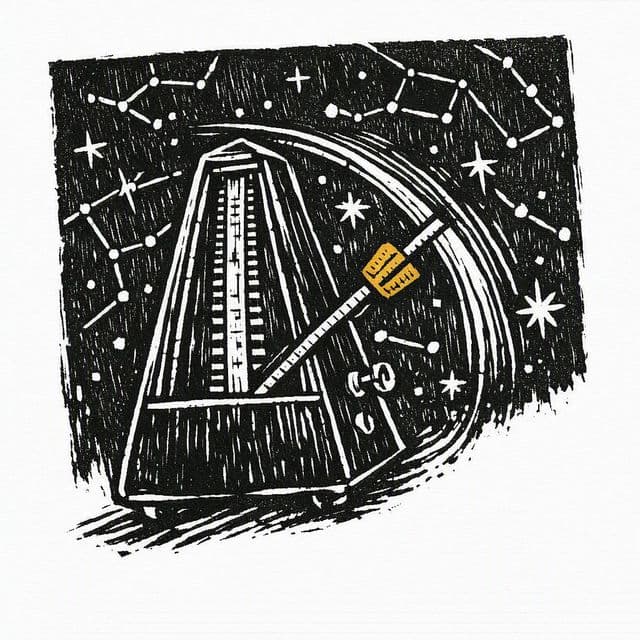
The Woman Who Built the Ruler for the Cosmos
In 1908, a Harvard 'computer' named Henrietta Leavitt noticed that certain pulsing stars flickered on a fixed schedule tied to their brightness. That single pattern became the yardstick that let astronomers measure cosmic distances and prove the universe was vastly bigger than anyone imagined.
Listen in the Fylom app.
Harvard computers earned thirty cents an hour processing astronomical data on glass photographic plates.
Henrietta Swan Leavitt discovered that a Cepheid star's pulse timing reveals its true intrinsic brightness.
The period-luminosity relationship established the first reliable standard candle for measuring deep space.
Leavitt's Law allowed astronomers to map the universe in three dimensions for the first time.
Edwin Hubble used Leavitt's calculations to prove that Andromeda was a separate galaxy.
Modern supercomputer measurements confirm that Leavitt's nineteen twelve data remains remarkably accurate.
- 01Intro1 min
- 02The Harvard Computers2 min
- 03The Pattern in the Clouds2 min
- 04Leavitt's Law and the Standard Candle2 min
- 05Measuring the Universe3 min
- 06The Enduring Yardstick1 min
- 07Outro1 min
- Period-luminosity relation - Wikipedia
- Henrietta Swan Leavitt - Wikipedia
- Leavitt's Law – or: The Woman Who Changed Astronomy
- A Re-analysis of the First Cepheid Period-Luminosity ...
- Henrietta Swan Leavitt | National Women's History Museum
- Henrietta Swan Leavitt and the Light of the Cepheids
- A Science Odyssey: People and Discoveries: Leavitt discovers a correlation between Cepheids' period and luminosity
- Henrietta Swan Leavitt | Biography & Facts | Britannica
- Henrietta Swan Leavitt | The Harvard Plate Stacks
- Period-Luminosity Relation for Variable Stars - Astronomy Notes
- Leavitt Discovers How to Measure Galactic Distances
- BEA
Fylom generates episodes like this on any topic you're curious about.
Fylom episodes are researched, written, and voiced by AI. Automated checks help catch inaccuracies, but episodes aren't reviewed by a human and AI can still get things wrong. Treat them as a starting point, not a source of record — more in our accuracy disclaimer.