
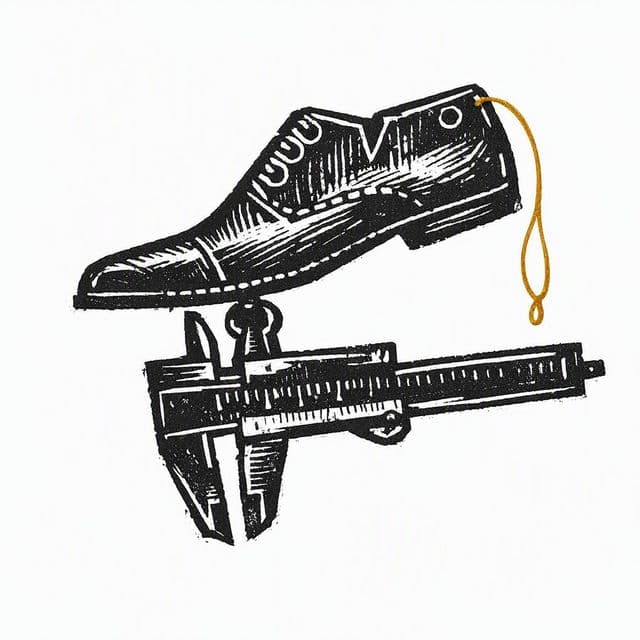
The Device That Defined the Foot
Before the 1880s, buying shoes was a gamble of cobblers and guesswork. This episode traces how Charles Brannock and Edwin Simpson turned the messy human foot into a standardized number, and why the industrial systems we trust still struggle to fit the diversity of human bodies.
Listen in the Fylom app.
Modern shoe sizes are still based on the medieval measurement of three barleycorns equaling one inch.
Charles Brannock invented his device because simple rulers failed to measure foot volume and arch length.
A shoe size eight could vary between different villages before standardization enabled mass production.
The Brannock device accounts for a two-thirds of an inch functional allowance for natural walking movement.
Standardized sizing prioritizes manufacturing efficiency and supply chain interoperability over individual foot diversity.
New digital models use three dimensional mapping to move beyond traditional one-third-of-an-inch barleycorn increments.
- 01Intro1 min
- 02The Chaos of the Cobbler2 min
- 03The Brannock Intervention3 min
- 04The Standardized Body2 min
- 05Beyond the Last2 min
- 06Outro1 min
- Fit for You: A Short History of Sizing
- The History of Shoe Sizes: Where Do They Come From?
- Why Men & Women Have Different Shoe Sizes - History Facts
- The diversity of footwear sizing systems - SATRA
- The Mystery of Shoe Sizing
- How did they come up with the numbers for shoe sizes?
- A Bit about Sizing Systems - American Duchess Blog
- Shoe Sizes: How Did They Evolve Through History And Measurement Systems? [Updated:July 2025]
- The Evolution of Shoe Sizing: From Ancient Times to Today
- Shoe size
- Why Are Shoe Sizes Gendered? Anatomy and History
- Free Shoe Size Converter 2026 — US, UK, EU & CM
- Guide – Shoe sizes
- Standardisation in AM
- Manufacturing Standards | IEEE Technology Navigator
- ISO - International Organization for Standardization
- Product Standardization and Specifications - ASME
Fylom generates episodes like this on any topic you're curious about.
Fylom episodes are researched, written, and voiced by AI. Automated checks help catch inaccuracies, but episodes aren't reviewed by a human and AI can still get things wrong. Treat them as a starting point, not a source of record — more in our accuracy disclaimer.